Diazepam
| Valium | |
|---|---|
 |
| Salts [] | |
|---|---|
| Diazepam hydrochloride | |
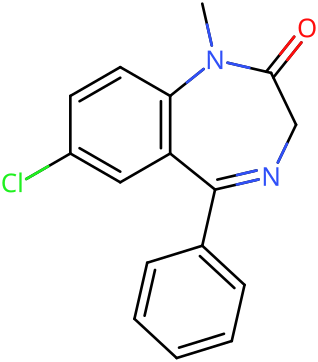
| Molecular structure via molpic based on CDK |
| Physical properties [] | |
|---|---|
| Molecular mass | 284.74 g/mol [1] |
| Appearance | Colorless to light yellow crysytals [1] |
| Odor | Practically no odor [1] |
| Melting point | 257 to 259 °F (NTP, 1992) [1] |
| Decomposition | When heated to decomp it emits very toxic fumes of hydrogen chloride and NO(x) [1] |
| Solubility | less than 1 mg/mL at 68 °F (NTP, 1992) [1] |
| Predicted LogP | 3 [1] |
| Structural Identifiers [] | |
|---|---|
| Molecular formula | C16H13ClN2O [1] |
| IUPAC name | 7-chloro-1-methyl-5-phenyl-3H-1,4-benzodiazepin-2-one [1] |
| SMILES | CN1C(=O)CN=C(C2=C1C=CC(=C2)Cl)C3=CC=CC=C3 [1] |
| InChI | InChI=1S/C16H13ClN2O/c1-19-14-8-7-12(17)9-13(14)16(18-10-15(19)20)11-5-3-2-4-6-11/h2-9H,10H2,1H3 [1] |
| InChIKey | AAOVKJBEBIDNHE-UHFFFAOYSA-N [1] |
| Pharmacokinetics[] | |
|---|---|
| Elimination half-life | (50 hours); 20 – 100 hours (32 – 200 hours for main active metabolite desmethyldiazepam)[5] |
| Dosing[] |
|---|
| Oral [] | |
|---|---|
| Light | ≤ 9.5 mg(30x - 25.6%) |
| Common | 9.5 - 10 mg(37x - 31.6%) |
| Strong | 10 - 20 mg(37x - 31.6%) |
| Heavy | 20 - 29.2 mg |
| Extreme | 29.2 mg +(13x - 11.1%) |
Statistically derived dosages via DBI-IGS We do not take any responsibility for medical complications or loss of life sustained by following these dosages blindly. |
Diazepam (also known as Diazepam, Valium, Ansiolisina, Diazemuls, Apaurin, Faustan, Relanium, Seduxen, Sibazon or Stesolid) is a
Chemistry
Salts []
Diazepam is typically found in the form of its hydrochloride salt.
Stereochemistry []
Diazepam is a achiral mixture.
Pharmacology
ATC Classification
In the nervous system (N) diazepam acts as a anxiolytic (N05B), benzodiazepine derivative (N05BA), diazepam (N05BA01) and psycholeptic (N05).[1]Subjective effects []
| Mere / Diazepam [] | |
|---|---|
| magnus / Diazepam [] | |
|---|---|
Routes:
| |
| nervewing / Diazepam [] | |
|---|---|
| alina / Diazepam [] | |
|---|---|
Routes:
| |
| bonzi / Diazepam [] | |
|---|---|
Routes:
| |
| Pilz / Diazepam [] | |
|---|---|
Routes:
| |
| emily / Diazepam [] | |
|---|---|
Routes:
| |
| 0xea / Diazepam [] | |
|---|---|
Routes:
| |
Experience reports
Erowid
There are currently 26 experience reports involving diazepam on Erowid: []
- "Absolutely No Effect" by Olivia Monteith
- "Not Noticing Anything From It" by Hel M
- "Could Not Sleep No Matter What" by suklaa
- "Anxiety Buster, but Not Used to Get 'High'" by Thrombocyte
- "Slow Motion" by VampB.
- "I'm Stuck with a Valuble Friend" by Chatterbox
- "I Really Liked It" by annoymous
- "Whoa, What the Fuck Happened?" by Drake
- "Mild but Pleasant" by ScaredofFlying
- "Helped Chills and Sweats" by Contourcrown
- "Valium Log" by Murple
- "Flyin' on a Magic Carpet" by Marc D
- "Mellow Yellow Fellow" by SuperDuper
- "Like Sailing away...Minus the Costly Yacht" by pharmgirl101
- "Will Do Again" by OpiateFighter
- "Greatest Drug Known to Man" by Mad Merv
- "Usually These Have Very Little Effect on Me" by thechap
- "Like Pulling Teeth (But Better)" by Soleta
- "Vaginal Insertion" by Gloria
- "Back to Reality Again" by Seroquel Lover
- "My Corporate Job Drug Test Experience" by Pissinhappiness
- "Distance Between Reality and Myself" by Lex
- "Blacked Out" by Jahkaya
- "Fighting the Hooch" by Jib Jib
- "Relaxation, Slight Dizziness" by crls
- "Kill the Christmas Tree" by A grateful addict
Legal status []
- Australia: Diazepam is a S4 substance.[3]
- Brazil: Diazepam is a B1 substance.
- Canada: Diazepam is a Schedule IV substance.
- Germany: Diazepam is a prescription only/Anlage III substance.
- New Zealand: Diazepam is a Class C5 substance.
- United Kingdom: Diazepam is a Class C substance.[4]
- United States: Diazepam is a Schedule I under the "Controlled Substances Act (CSA)".
- European Union: Diazepam is a prescription only substance.
- United Nations: Diazepam is a schedule IV substance.
See also []
- Substituted benzodiazepines (benzos)
External links []
References []
National Center for Biotechnology Information. PubChem Compound Summary for CID 3016, Diazepam. Accessed May 3, 2026. https://pubchem.ncbi.nlm.nih.gov/compound/3016
U.S. Food and Drug Administration; National Center for Advancing Translational Sciences. Diazepam. UNII: Q3JTX2Q7TU. Global Substance Registration System. Accessed May 3, 2026. https://gsrs.ncats.nih.gov/ginas/app/beta/substances/Q3JTX2Q7TU
Valium. January 31, 2020. Accessed May 3, 2026. https://www.nps.org.au/medicine-finder/valium-tablets#full-pi
Misuse of Drugs Act 1971}. Accessed May 3, 2026. https://www.legislation.gov.uk/ukpga/1971/38/schedule/2/part/III/paragraph/1
Diazepam Tablets BP 10 mgs – Summary of Product Characteristics (SmPC). September 16, 2019. Accessed May 3, 2026. https://www.medicines.org.uk/emc/product/4522/smpc