Theophylline
| Theophylline | |
|---|---|
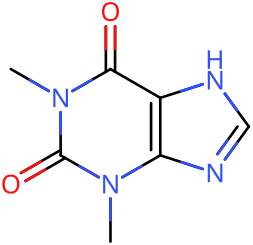 | |
| Molecular structure via molpic based on CDK |
| Rotamer [] | |
|---|---|
| Conformer structure via 3Dmol.js |
| Physical properties [] | |
|---|---|
| Molecular mass | 180.16 g/mol [1] |
| Density | g/cm³ g/cm3 [1] |
| Appearance | White, crystalline alkaloid [1] |
| Odor | Odorless [1] |
| Taste | Bitter [1] |
| Melting point | 522 to 525 °F (NTP, 1992) [1] |
| Decomposition | When heated to decomposition it emits toxic fumes of /nitrogen oxides/. [1] |
| Solubility | 1 to 5 mg/mL at 70.7 °F (NTP, 1992) [1] |
| Structural Identifiers [] | |
|---|---|
| Molecular formula | C7H8N4O2 [1] |
| IUPAC name | 1,3-dimethyl-7H-purine-2,6-dione [1] |
| SMILES | CN1C2=C(C(=O)N(C1=O)C)NC=N2 [1] |
| InChI | InChI=1S/C7H8N4O2/c1-10-5-4(8-3-9-5)6(12)11(2)7(10)13/h3H,1-2H3,(H,8,9) [1] |
| InChIKey | ZFXYFBGIUFBOJW-UHFFFAOYSA-N [1] |
| Pharmacokinetics[] | |
|---|---|
| Elimination half-life | 5 – 8 hours |
Theophylline (also known as 1,3-Dimethylxanthine, Elixophyllin, Theophyllin, Theolair, Nuelin, Theophylline anhydrous, Elixophylline, Lanophyllin, Pseudotheophylline or Respbid) is a
Chemistry
Stereochemistry []
Theophylline is a achiral mixture.
Pharmacology
ATC Classification
In the respiratory system (R) theophylline actsInteractions []
| CYP1A2 | induction / inhibition |
|---|
Legal status []
- Australia: Theophylline is a S4 substance.
- Canada: Theophylline is a prescription only substance.
- United Kingdom: Theophylline is a P substance.
- United States: Theophylline is a prescription only substance.
See also []
External links []
References []
National Center for Biotechnology Information. PubChem Compound Summary for CID 2153, theophylline. Accessed May 5, 2026. https://pubchem.ncbi.nlm.nih.gov/compound/2153
U.S. Food and Drug Administration; National Center for Advancing Translational Sciences. Theophylline. UNII: 0I55128JYK. Global Substance Registration System. Accessed May 5, 2026. https://gsrs.ncats.nih.gov/ginas/app/beta/substances/0I55128JYK