Thiamine
| vitamin B1 | |
|---|---|
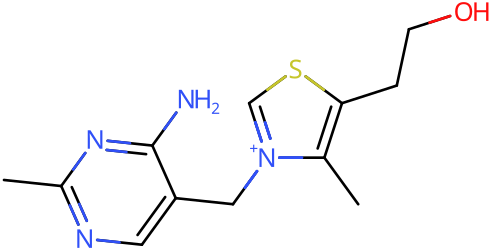 | |
| Molecular structure via molpic based on CDK |
| Rotamer [] | |
|---|---|
| Conformer structure via 3Dmol.js |
| Physical properties [] | |
|---|---|
| Molecular mass | 265.36 g/mol [1] |
| Appearance | Crystals from water [1] |
| Odor | SLIGHT, CHARACTERISTIC [1] |
| Melting point | 164 °C [1] |
| Decomposition | When heated to decomposition it emits very toxic fumes of /nitric oxide/, /sulfur oxide/, and /chlorine/. [1] |
| Solubility | SLIGHTLY SOL IN ALC & CHLOROFORM /MONONITRATE/ [1] |
| Predicted LogP | 1 [1] |
| Structural Identifiers [] | |
|---|---|
| Molecular formula | C12H17N4OS+ [1] |
| IUPAC name | 2-[3-[(4-amino-2-methylpyrimidin-5-yl)methyl]-4-methyl-1,3-thiazol-3-ium-5-yl]ethanol [1] |
| SMILES | CC1=C(SC=[N+]1CC2=CN=C(N=C2N)C)CCO [1] |
| InChI | InChI=1S/C12H17N4OS/c1-8-11(3-4-17)18-7-16(8)6-10-5-14-9(2)15-12(10)13/h5,7,17H,3-4,6H2,1-2H3,(H2,13,14,15)/q+1 [1] |
| InChIKey | JZRWCGZRTZMZEH-UHFFFAOYSA-N [1] |
| Pharmacokinetics[] | |
|---|---|
| Elimination half-life | 1 – 12 h |
Thiamine (also known as Thiamine, thiamin, vitamin B1, Aneurin, Antiberiberi factor, βxin, thiaminium, Bewon, thiamine(1+) ion or βbion)
Chemistry
Stereochemistry []
Thiamine is a achiral mixture.
Pharmacology
ATC Classification
In the alimentary tract and metabolism (A) thiamine actsLegal status []
- United States: Thiamine is a OTC substance.
See also []
External links []
References []
National Center for Biotechnology Information. PubChem Compound Summary for CID 1130, Thiamine. Accessed February 17, 2026. https://pubchem.ncbi.nlm.nih.gov/compound/1130
U.S. Food and Drug Administration; National Center for Advancing Translational Sciences. Thiamine. UNII: 4ABT0J945J. Global Substance Registration System. Accessed February 17, 2026. https://gsrs.ncats.nih.gov/ginas/app/beta/substances/4ABT0J945J