Synephrine
| Synephrine | |
|---|---|
 |
| Salts [] | |
|---|---|
| Synephrine hemisulfate | |
| Synephrine hydrochloride | |
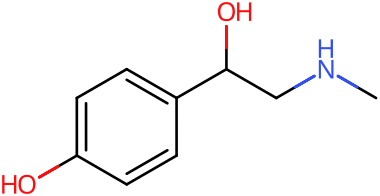
| Molecular structure via molpic based on CDK |
| Physical properties [] | |
|---|---|
| Molecular mass | 167.20 g/mol [1] |
| Predicted LogP | -0.6 [1] |
| Structural Identifiers [] | |
|---|---|
| Molecular formula | C9H13NO2 [1] |
| IUPAC name | 4-[1-hydroxy-2-(methylamino)ethyl]phenol [1] |
| SMILES | CNCC(C1=CC=C(C=C1)O)O [1] |
| InChI | InChI=1S/C9H13NO2/c1-10-6-9(12)7-2-4-8(11)5-3-7/h2-5,9-12H,6H2,1H3 [1] |
| InChIKey | YRCWQPVGYLYSOX-UHFFFAOYSA-N [1] |
Synephrine (also known as Synephrine, Oxedrine, 94-07-5, p-Synephrine, Parasympatol, Analeptin, Sympatol, Simpalon, Synthenate or Sympathol) is a sympathomimetic substance of the phenylethanolamine class.
Chemistry
Salts []
Synephrine is typically found in the form of its hemisulfate and hydrochloride salts.
Stereochemistry []
Synephrine is a racemic mixture of the enantiomers.
Pharmacology
ATC Classification
In the cardiovascular system (C) synephrine acts In the sensory organs (S) synephrine actsSubjective effects []
See also []
External links []
References []
National Center for Biotechnology Information. PubChem Compound Summary for CID 7172, Synephrine. Accessed February 17, 2026. https://pubchem.ncbi.nlm.nih.gov/compound/7172
U.S. Food and Drug Administration; National Center for Advancing Translational Sciences. Synephrine. UNII: PEG5DP7434. Global Substance Registration System. Accessed February 17, 2026. https://gsrs.ncats.nih.gov/ginas/app/beta/substances/PEG5DP7434