Aniline
| Aniline | |
|---|---|
 |
| Salts [] | |
|---|---|
| Aniline hydrochloride | |
| Aniline hemihemisulfate | |
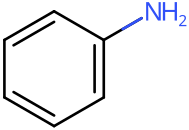
| Molecular structure via molpic based on CDK |
| Rotamer [] | |
|---|---|
| Conformer structure via 3Dmol.js |
| Physical properties [] | |
|---|---|
| Molecular mass | 93.13 g/mol [1] |
| Density | 1.022 at 68 °F (EPA, 1998) - Denser than water; will sink g/cm3 [1] |
| Appearance | Oily liquid; colorless when freshly distilled, darkens on exposure to air and light [1] |
| Odor | Hedonic tone; pungent [1] |
| Taste | Burning taste [1] |
| Melting point | 21 ° [1] |
| Boiling point | 363 to 367 °F at 760 mmHg (EPA, 1998) [1] |
| Decomposition | Hazardous decomposition products formed under fire conditions - Carbon oxides, nitrogen oxides (NOx). [1] |
| Solubility | 10 to 50 mg/mL at 73 °F (NTP, 1992) [1] |
| Predicted LogP | 0.9 [1] |
| Structural Identifiers [] | |
|---|---|
| Molecular formula | C6H7N [1] |
| IUPAC name | aniline [1] |
| SMILES | C1=CC=C(C=C1)N [1] |
| InChI | InChI=1S/C6H7N/c7-6-4-2-1-3-5-6/h1-5H,7H2 [1] |
| InChIKey | PAYRUJLWNCNPSJ-UHFFFAOYSA-N [1] |
Aniline (also known as Aniline, Benzenamine, 62-53-3, Phenylamine, Aminobenzene, Aminophen, Arylamine, Kyanol, Cyanol or Anilin) is a
Chemistry
Salts []
Aniline is typically found in the form of its hydrochloride and hemihemisulfate salts.
Stereochemistry []
Aniline is a achiral mixture.
See also []
External links []
References []
National Center for Biotechnology Information. PubChem Compound Summary for CID 6115, Aniline. Accessed March 5, 2026. https://pubchem.ncbi.nlm.nih.gov/compound/6115
U.S. Food and Drug Administration; National Center for Advancing Translational Sciences. Aniline. UNII: SIR7XX2F1K. Global Substance Registration System. Accessed March 5, 2026. https://gsrs.ncats.nih.gov/ginas/app/beta/substances/SIR7XX2F1K