1,4-Butanediol
| 1,4-BDO | |
|---|---|
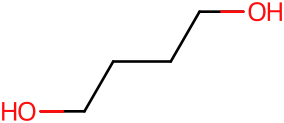 | |
| Molecular structure via molpic based on CDK |
| Physical properties [] | |
|---|---|
| Molecular mass | 90.12 g/mol [1] |
| Density | 1.017 at 68 °F (USCG, 1999) - Denser than water; will sink g/cm3 [1] |
| Appearance | Colorless, oily liquid [1] |
| Odor | Almost odorless [1] |
| Melting point | 61 ° [1] |
| Boiling point | 446 ° [1] |
| Decomposition | When heated to decomposition it emits acrid smoke and fumes. [1] |
| Solubility | greater than or equal to 100 mg/mL at 73 °F (NTP, 1992) [1] |
| Predicted LogP | -0.8 [1] |
| Structural Identifiers [] | |
|---|---|
| Molecular formula | C4H10O2 [1] |
| IUPAC name | butane-1,4-diol [1] |
| SMILES | C(CCO)CO [1] |
| InChI | InChI=1S/C4H10O2/c5-3-1-2-4-6/h5-6H,1-4H2 [1] |
| InChIKey | WERYXYBDKMZEQL-UHFFFAOYSA-N [1] |
1,4-Butanediol (also known as Butane-1,4-diol, Tetramethylene glycol, 1,4-Butylene glycol, 1,4-Dihydroxybutane, 1,4-Tetramethylene glycol, Sucol B, Tetramethylene 1,4-diol, DIOL 14B, 1,4-BD or Agrisynth B1D)
Chemistry
Stereochemistry []
1,4-Butanediol is a achiral mixture.
Subjective effects []
| michalina / 1,4-Butanediol [] | |
|---|---|
Effects:
| |
| magnus / 1,4-Butanediol [] | |
|---|---|
Routes:
| |
Experience reports
Erowid
There are currently 26 experience reports involving 1,4-butanediol on Erowid: []
- "Gently Hugging the Body" by shinybeast
- "Not Worth It" by III
- "Helpful for Me" by anonymous
- "Good Anxiolytic, Okay Recreational Substance" by bill
- "I Expected This to Help Me" by ThirdCultureDude
- "For Growth Hormone" by S. Kamack
- "Whats All the Fuss About?" by Cimora
- "Dreaming Without Sleeping" by Catfish Rivers
- "Used as an Antidepressant" by JG
- "Nasty Headache" by Itsuoda
- "A Nice High Turned Nightmarish" by Sasha
- "Not All People Experience Addiction" by Tom
- "1,4-B Is Not a Toy" by Anonymous
- "Never Again" by Ashley
- "Quite Synergistic Subcutaneous Experiment" by Mr. Hazlitt
- "Start Small and Take 1/2 of That" by Daphne
- "A Wife's Point of View" by pov
- "Toxicity After Infrequent Use" by Meat Nipples
- "Blissful Synergy" by DrStawBrain
- "Not a Good Idea" by G-head
- "Relaxed, Pro Social" by jarmen
- "As Easy as Pie" by Dirk
- "Mischt es Nicht!" by brainbug
- "Most Intense Pleasure" by rollergirl76
- "Life Force" by Grug
- "Tips for Withdrawing" by Graham
External links []
References []
National Center for Biotechnology Information. PubChem Compound Summary for CID 8064, 1,4-Butanediol. Accessed May 7, 2026. https://pubchem.ncbi.nlm.nih.gov/compound/8064
U.S. Food and Drug Administration; National Center for Advancing Translational Sciences. 1,4-Butanediol. UNII: 7XOO2LE6G3. Global Substance Registration System. Accessed May 7, 2026. https://gsrs.ncats.nih.gov/ginas/app/beta/substances/7XOO2LE6G3