Glucose
| Glucose | |
|---|---|
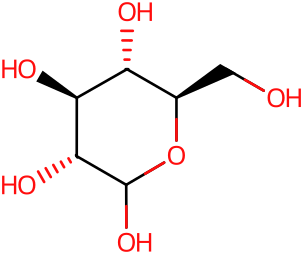 | |
| Molecular structure via molpic based on CDK |
| Physical properties [] | |
|---|---|
| Molecular mass | 180.16 g/mol [1] |
| Density | 1.2 at 68 °F (est.) (USCG, 1999) - Denser than water; will sink g/cm3 [1] |
| Appearance | Colorless crystals or white granular powder [1] |
| Odor | Odorless [1] |
| Taste | Sweet [1] |
| Melting point | less than 32 °F (USCG, 1999) [1] |
| Boiling point | greater than 212 °F at 760 mmHg (USCG, 1999) [1] |
| Decomposition | When heated to decomposition it emits acrid smoke and irritating fumes. [1] |
| Solubility | Soluble [1] |
| Predicted LogP | -2.6 [1] |
| Structural Identifiers [] | |
|---|---|
| Molecular formula | C6H12O6 [1] |
| IUPAC name | (3R,4S,5S,6R)-6-(hydroxymethyl)oxane-2,3,4,5-tetrol [1] |
| SMILES | C([C@@H]1[C@H]([C@@H]([C@H](C(O1)O)O)O)O)O [1] |
| InChI | InChI=1S/C6H12O6/c7-1-2-3(8)4(9)5(10)6(11)12-2/h2-11H,1H2/t2-,3-,4+,5-,6?/m1/s1 [1] |
| InChIKey | WQZGKKKJIJFFOK-GASJEMHNSA-N [1] |
Glucose (also known as Glucose, Glucopyranose, Glc, Blood sugar, Grape sugar, Traubenzucker, Glucosteril, Cartose, anhydrous glucose or Maxim Energy Gel)
Chemistry
Stereochemistry []
Glucose is a racemic mixture of the enantiomers.
Pharmacology
ATC Classification
In the various (V) glucose acts In the blood and blood forming organs (B) glucose acts In the various (V) glucose actsExternal links []
References []
National Center for Biotechnology Information. PubChem Compound Summary for CID 5793, Glucose. Accessed February 17, 2026. https://pubchem.ncbi.nlm.nih.gov/compound/5793