Chlorobutanol
| Chlorobutanol | |
|---|---|
 |
| Salts [] | |
|---|---|
| Chlorobutanol hemihydrate | |
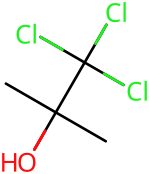
| Molecular structure via molpic based on CDK |
| Physical properties [] | |
|---|---|
| Molecular mass | 177.45 g/mol [1] |
| Appearance | NEEDLES (WATER+1) [1] |
| Odor | Camphor odor [1] |
| Taste | Camphor taste [1] |
| Melting point | 97 °C [1] |
| Boiling point | 167 °C [1] |
| Decomposition | When heated to decomposition it emits toxic fumes of /hydrogen chloride/. [1] |
| Solubility | INSOL IN COLD WATER, SOL IN HOT WATER [1] |
| Predicted LogP | 2 [1] |
| Structural Identifiers [] | |
|---|---|
| Molecular formula | C4H7Cl3O [1] |
| IUPAC name | 1,1,1-trichloro-2-methylpropan-2-ol [1] |
| SMILES | CC(C)(C(Cl)(Cl)Cl)O [1] |
| InChI | InChI=1S/C4H7Cl3O/c1-3(2,8)4(5,6)7/h8H,1-2H3 [1] |
| InChIKey | OSASVXMJTNOKOY-UHFFFAOYSA-N [1] |
Chlorobutanol (also known as Chlorbutol, 1,1,1-Trichloro-2-methyl-2-propanol, CHLORETONE, Chloreton, Acetone chloroform, Acetonchloroform, Acetochlorone, Clortran, Methaform or Sedaform)
Chemistry
Salts []
Chlorobutanol is typically found in the form of its hemihydrate salt.
Stereochemistry []
Chlorobutanol is a achiral mixture.
Pharmacology
ATC Classification
In the alimentary tract and metabolism (A) chlorobutanol actsExperience reports
Erowid
There are currently 1 experience reports involving chlorobutanol on Erowid: []
See also []
External links []
References []
National Center for Biotechnology Information. PubChem Compound Summary for CID 5977, Chlorobutanol. Accessed May 5, 2026. https://pubchem.ncbi.nlm.nih.gov/compound/5977
U.S. Food and Drug Administration; National Center for Advancing Translational Sciences. Chlorobutanol. UNII: HM4YQM8WRC. Global Substance Registration System. Accessed May 5, 2026. https://gsrs.ncats.nih.gov/ginas/app/beta/substances/HM4YQM8WRC