Ascorbic acid
| vitamin C | |
|---|---|
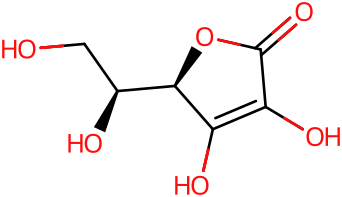 | |
| Molecular structure via molpic based on CDK |
| Physical properties [] | |
|---|---|
| Molecular mass | 176.12 g/mol [1] |
| Density | 1.65 (NTP, 1992) - Denser than water; will sink g/cm3 [1] |
| Appearance | Crystals (usually plates, sometimes needles, monoclinic system) [1] |
| Odor | Odorless [1] |
| Taste | Pleasant, sharp, acidic taste [1] |
| Melting point | 374 to 378 °F (decomposes) (NTP, 1992) [1] |
| Decomposition | When heated to decomposition it emits acrid smoke and irritating fumes. [1] |
| Solubility | greater than or equal to 100 mg/mL at 73 °F (NTP, 1992) [1] |
| Predicted LogP | -1.6 [1] |
| Structural Identifiers [] | |
|---|---|
| Molecular formula | C6H8O6 [1] |
| IUPAC name | (2R)-2-[(1S)-1,2-dihydroxyethyl]-3,4-dihydroxy-2H-furan-5-one [1] |
| SMILES | C([C@@H]([C@@H]1C(=C(C(=O)O1)O)O)O)O [1] |
| InChI | InChI=1S/C6H8O6/c7-1-2(8)5-3(9)4(10)6(11)12-5/h2,5,7-10H,1H2/t2-,5+/m0/s1 [1] |
| InChIKey | CIWBSHSKHKDKBQ-JLAZNSOCSA-N [1] |
Ascorbic acid (also known as Ascorbic Acid, ascorbic acid, vitamin C, 50-81-7, L(+)-Ascorbic acid, Ascoltin, Ascorbicap, Cevitamic acid, Allercorb or Ascorbajen) is a vitamin substance of the carboxylic acid class.
Chemistry
Stereochemistry []
Ascorbic acid is a absolute mixture.
Pharmacology
ATC Classification
In the sensory organs (S) ascorbic acid acts In the genito urinary system and sex hormones (G) ascorbic acid acts In the alimentary tract and metabolism (A) ascorbic acid actsSubjective effects []
| 0xea / Ascorbic acid [] | |
|---|---|
Routes:
| |
See also []
External links []
References []
National Center for Biotechnology Information. PubChem Compound Summary for CID 54670067, Ascorbic Acid. Accessed February 17, 2026. https://pubchem.ncbi.nlm.nih.gov/compound/54670067
U.S. Food and Drug Administration; National Center for Advancing Translational Sciences. Ascorbic acid. UNII: PQ6CK8PD0R. Global Substance Registration System. Accessed February 17, 2026. https://gsrs.ncats.nih.gov/ginas/app/beta/substances/PQ6CK8PD0R